Illustrations / Projective structures
Projective structures for maximal representations
These illustrations concern projective structures associated to maximal representations into Sp(4,ℝ). Click an image to rotate the corresponding 3D model and inspect it from different viewpoints.
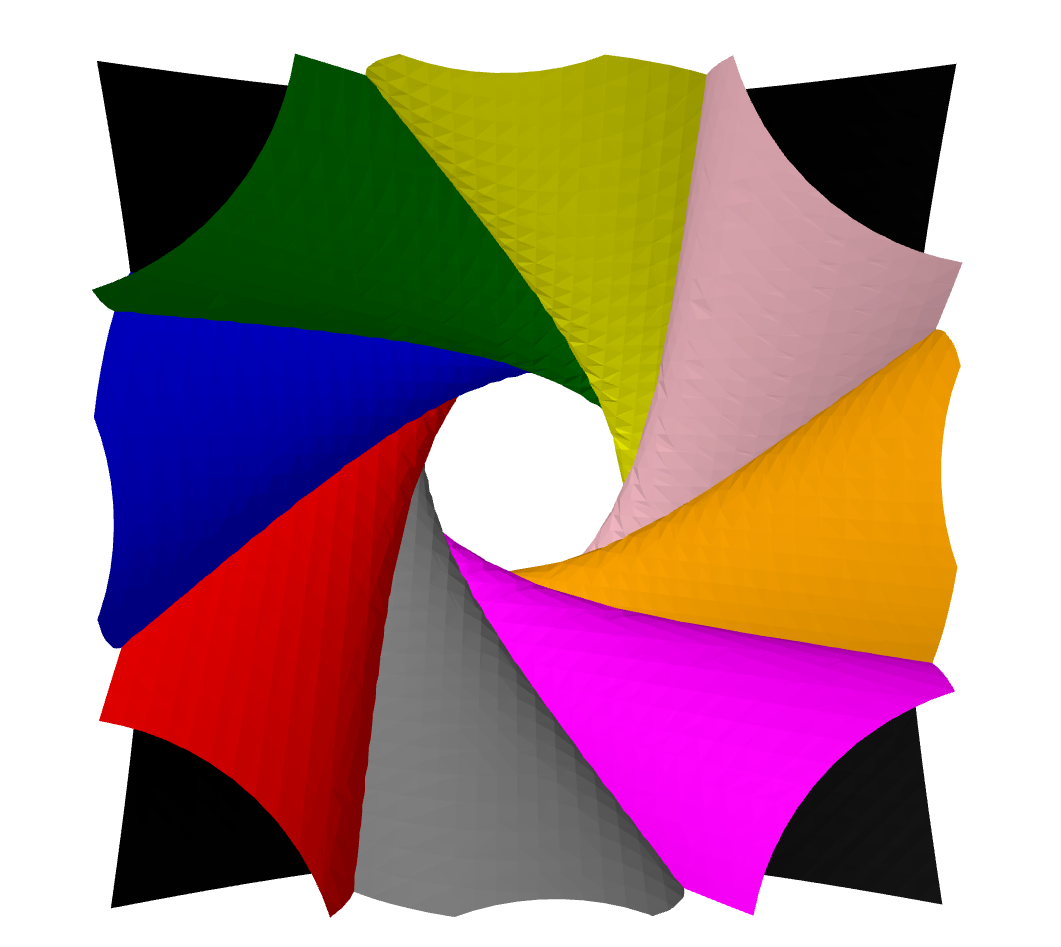
Regular octagon of hyperboloids
Start with a Fuchsian representation of the fundamental group of a genus 2 surface into SL(2,ℝ), identifying the sides of a regular hyperbolic octagon with angles π/4. Embed it reducibly into Sp(4,ℝ) through the diagonal representation. The resulting maximal representation preserves a domain of discontinuity in ℝP³.
In this case the domain is the complement of the black hyperboloid and has two connected components. Removing the interiors of the eight colored hyperboloids gives a fundamental domain. It can be constructed either as the boundary of a Dirichlet-Selberg domain or using quadrics attached to the limit map.
 Open 3D model ↗
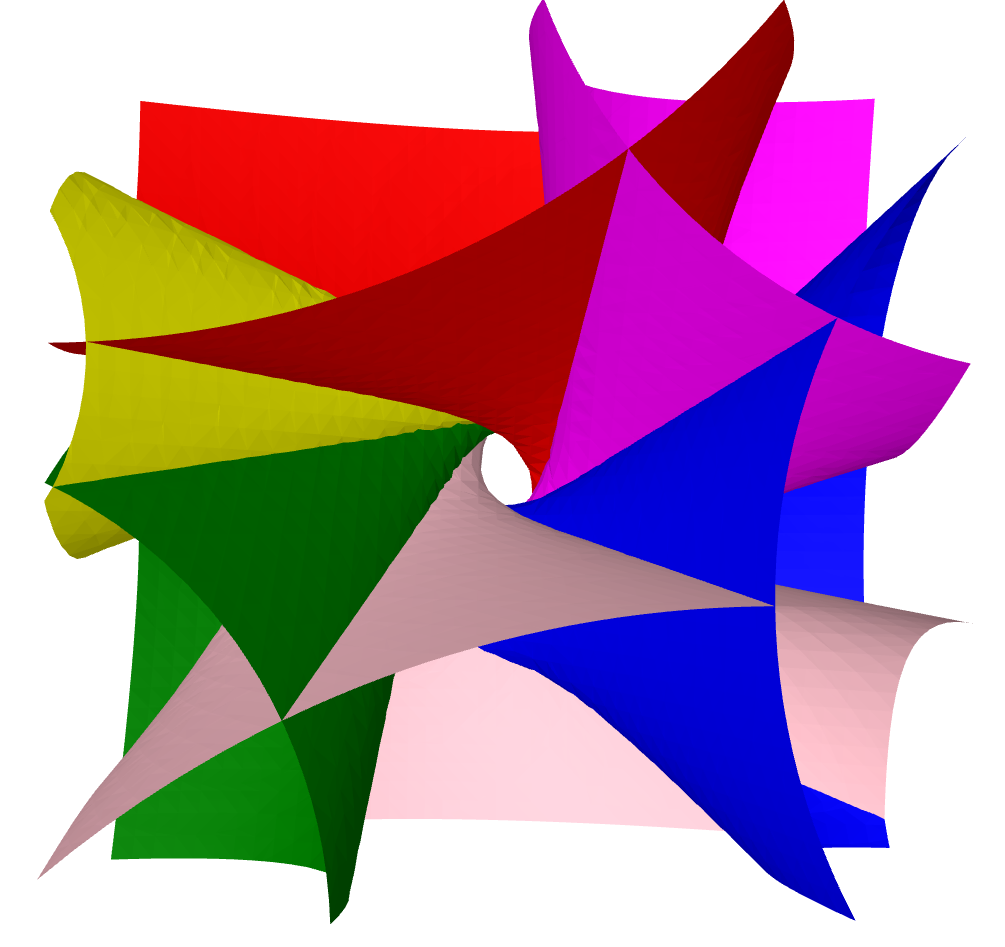
Reducible hexagon of hyperboloids
For any Fuchsian representation of a genus g ≥ 2 surface group into SL(2,ℝ), the same reducible embedding into Sp(4,ℝ) gives a maximal representation preserving a domain of discontinuity in ℝP³. Cutting the surface along simple closed curves decomposes it into hexagons. The domain can likewise be decomposed into hexagons of hyperboloids using quadrics attached to the limit map.
 Open 3D model ↗
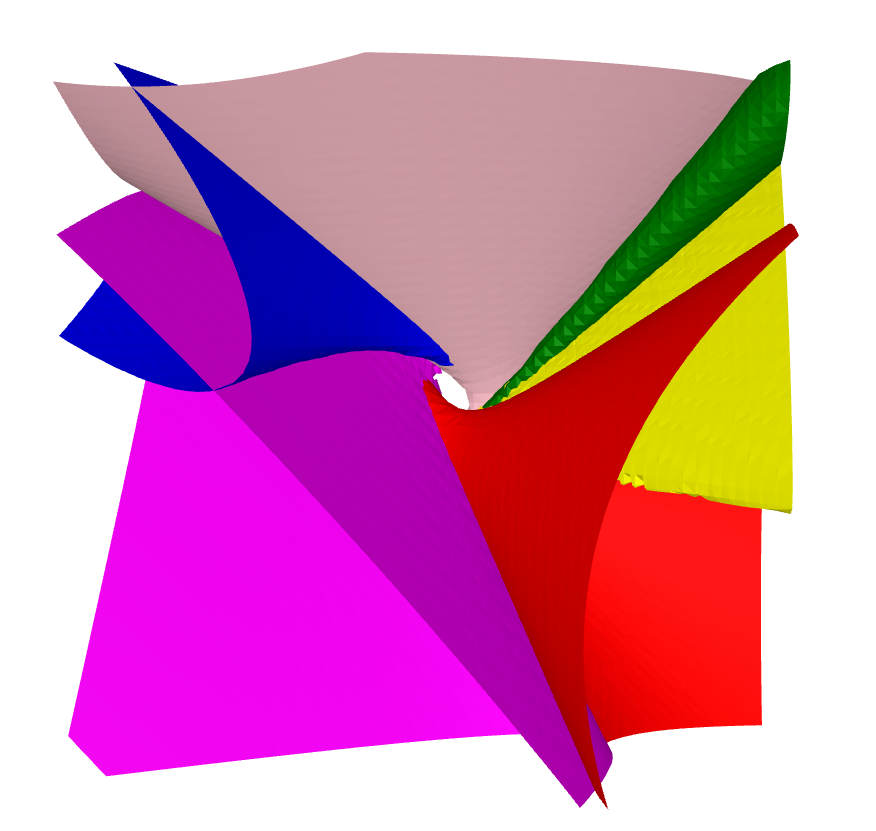
Irreducible hexagon of hyperboloids
Composing a Fuchsian representation with the irreducible representation of SL(2,ℝ) into Sp(4,ℝ) produces a Hitchin representation. Hitchin representations are maximal, so their projective domains of discontinuity can also be tiled by hexagons of hyperboloids. This is one such hexagon.
Here the intersection of two intersecting quadrics is topologically a union of two circles, but need not be a union of two projective lines, unlike in the reducible case.
 Open 3D model ↗
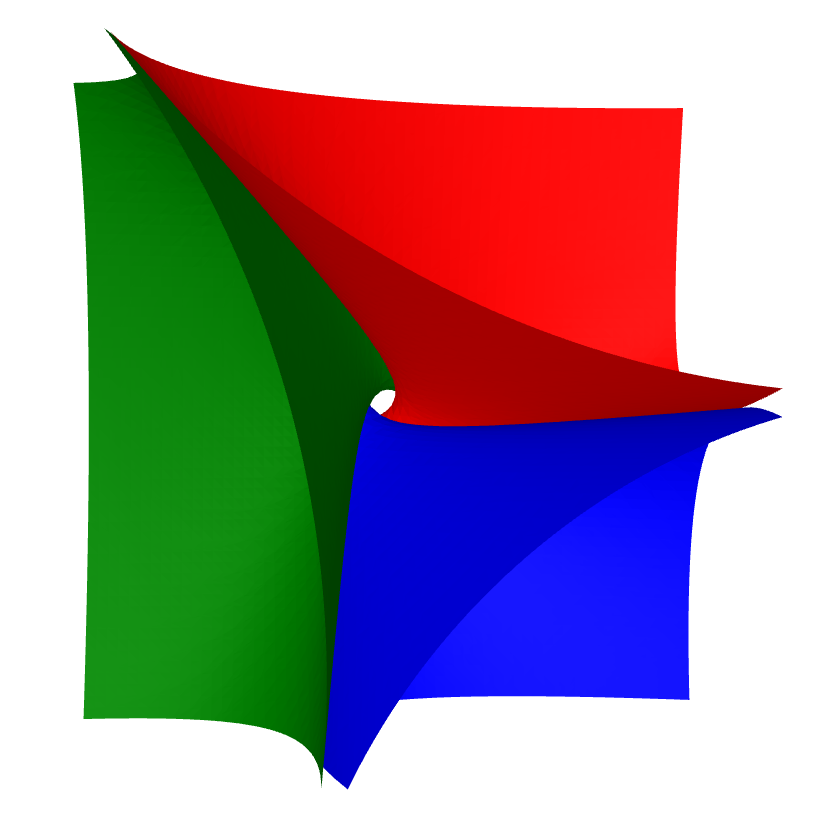
Ideal triangle of hyperboloids
Given any maximal surface group representation and a maximal lamination of the surface, its domain of discontinuity can be decomposed into ideal triangles of hyperboloids, or ideal triangles of photons; see the work of Mazzoli and Viaggi. All these triangles are equivalent to the one shown here under the action of PSp(4,ℝ) ≅ SO₀(2,3).
 Open 3D model ↗
Domains bounded by hyperboloids were studied for free group representations by Burelle and Treib; see their illustration.